FlemingClans.com

"Scotland's Fleming Clan: a Genealogical History" - coming in 2027!
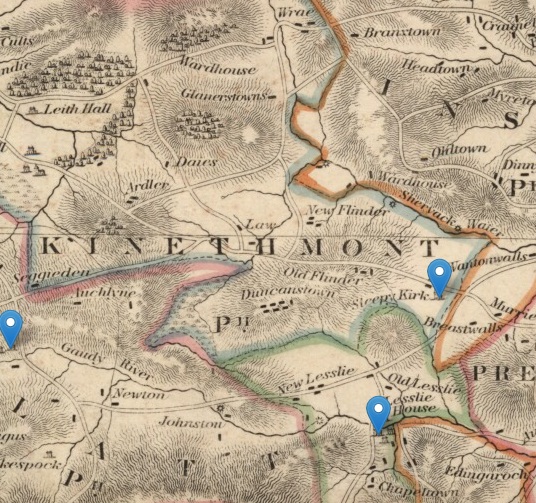 Robert Fleming of Wardhouse
(c1225 - 1291/1296)
Basic information about this person: \click here\
Robert Fleming of Wardhouse, in the Garioch district of Aberdeenshire, was one of the Scottish landholders who sealed the letters of Birgham in 1290. In recent years family historians have confused him with the legendary Robert Fleming said to have helped Robert the Bruce kill John Comyn in 1306. In fact Robert of Wardhouse was a Comyn kinsman by marriage, and he cannot have been that man.
Family background
Robert was born around 1225, a son of Bartholomew Flamang, 1st of Wardhouse, near Kennethmont and Leslie in Aberdeenshire, where his great-grandfather Bertolf had settled in the previous century.
Landholder in the north-east
Robert’s earliest recorded act was to witness, as R. Flandrensis, an agreement between Alan Durward, one of the most powerful men in Scotland, and Peter de Ramsay, Bishop of Aberdeen from 1247 to 1256. Between 1270 and 1282, as lord of Wardhouse, he granted his brother Michael the land of the ferryboat of Montrose, with the land of Hedderwick in Angus. Michael is remembered as Michael Fleming of Hedderwick
A Comyn marriage
Robert married Affrica le Chen. Some time before 1289 the couple, with their sons, petitioned the Pope through Henry le Chen, Bishop of Aberdeen, for a dispensation because they had unknowingly married within the fourth degree of kinship. The dispensation was needed to make sure their children were recognised as legitimate heirs. Pope Nicholas IV granted it on 19 June 1289, naming the couple as “Robert called Fleming, knight, and Affrica, daughter of the nobleman Reginald called ‘Lichen’, both of the diocese of Aberdeen”.
No Reginald Lichen is otherwise known, but Reginald le Chen of Inverugie was Chamberlain of Scotland from 1267 to 1269, and he was the elder brother of Bishop Henry le Chen, who handled the petition. The surname le Chen appears as Lichen in several Latin charters, so Affrica’s father was almost certainly Reginald le Chen.
Reginald’s first wife was a daughter of John Comyn, 1st Lord of Badenoch, and he often appears in the company of the Comyns, witnessing charters with Alexander Comyn, Earl of Buchan, in 1261 and at the foundation of Buchan’s hospital at Turriff a decade later. Through her mother, Affrica was a first cousin of John “the Red” Comyn, the man killed by Robert the Bruce at Dumfries in 1306.
The letters of Birgham
In 1286 King Alexander III died, leaving his granddaughter Margaret, the Maid of Norway, as heir. In March 1290 the Scottish nobles meeting at Birgham sealed letters to Edward I of England approving the Treaty of Salisbury and the marriage of Margaret to his son Edward, while safeguarding Scotland’s independence. Robert Fleming was among them, as was Nicholas of Biggar. Margaret died later that year, and Edward I used the resulting crisis to claim overlordship of Scotland.
Robert the Legend
Robert Fleming of Wardhouse must have died before 1296 because he did not sign the Ragman Rolls in that year.
From the sixteenth century onwards, family historians have claimed that a Robert Fleming was with Robert the Bruce at Lochmaben and at Greyfriars Church in Dumfries on 10 February 1306. They said he beheaded the wounded Comyn and declared “Let the deid shaw”, which became the family motto; that he was rewarded with the Barony of Lenzie; and that he was the father of Malcolm Fleming of Fulwood and Patrick Fleming of Biggar. James Balfour Paul repeated the story in 1911, identifying this Robert with the man who sealed the letters of Birgham.
The People of Medieval Scotland project has since identified the Birgham signatory as Robert Fleming of Wardhouse. The family historian F. Lawrence Fleming, who found Robert’s charter to his brother Michael, accepted that identification but argued that Robert of Wardhouse was also the Greyfriars hero. Robert’s Comyn connections rule this out. Through his wife he belonged firmly to the Comyn camp, and he would not have supported the Bruce claim, still less taken part in the murder of his wife’s cousin. In any case he was almost certainly dead by 1306, and he would have been about eighty, not the “worthy young gentleman” described in Holinshed’s Chronicles of 1580.
Every surviving contemporary record of a Robert Fleming can be attributed to Robert of Wardhouse, and none of the early chroniclers of the Comyn murder mention a Fleming at all. The Greyfriars Robert appears to be a later invention: “Robert the Legend”. If a Fleming really was with Bruce at Dumfries, he was most likely the young Malcolm Fleming of Fulwood, the actual recipient of the Barony of Lenzie.